
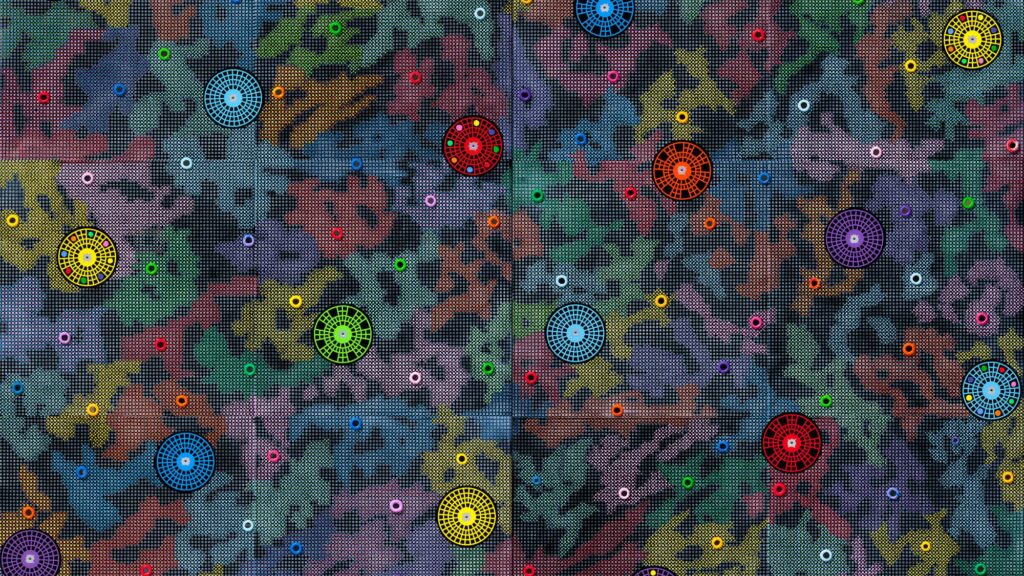
With bad news overload, it is easy to conclude it is time to disengage. But troubling events don’t go away just because you stop looking. Janenne Eaton’s retrospective reminds us that art can provide new perspectives and a reason to look even harder.
As a respected painter and teacher, Eaton has influenced generations of Australian artists. She has exhibited extensively in museums and galleries both nationally and internationally since 1978. “Lines of Sight – Frame and Horizon” is long overdue.
This comprehensive exhibition is aesthetically and intellectually compelling. The paintings, drawings, and installations offer complex, layered reflections on key moments from the last four decades.
Rather than adopting a linear chronology, artworks are clustered to prompt dialogues between works across time. Eaton’s technical mastery and dexterity produce deliberate ambiguities. Her recognizable motifs and grid patterns convey rich ideas about human rights, colonization, climate, and First Nations justice, all underpinned by existential questions about uncertainty and meaning.
Locked in or locked out?
Supersized artworks populate the first space – Eaton’s underground car park drawings (1982–86) and two works using fences, from 2016 and 2019. Both series use layering to represent built structures, but proximity to each other in the gallery emphasizes the differences.
The dusty, velvety surfaces of the car parks emphasize volume and perspective. The fences made from acrylic board and high-gloss enamel flatten and compress space.
In the car park series, Eaton’s knowledge of art history is apparent in her
Renaissance-influenced
use of light and perspective. Texture and surface have been achieved by papering the canvas with found photocopies.
Dense, sooty carbon extracted from ink cartridges smothers the solid areas, and light in touch graphite and charcoal drawings create an underground environment that some may find contemplative and others sinister.
They evoke an ambiguity of being simultaneously attracted and repelled. And there are sensory questions. Does it smell or echo? Is that the sun or artificial light? Is it hot or cold?
This series reflects Eaton’s training in archaeology and draws attention to the cultural significance of subterranean spaces. In a time of geopolitical turbulence and endemic inequality other readings are open to us.
In comparison, “Fences, Borders, Walls” (2016) clearly delineates who is confined and who is excluded. The foreground is dominated by sharply defined geometric shapes; the word “fence” is mirrored and repeated, reducing its readability but adding structural weight as both a physical and psychological barrier.
The small diamond grid is immediately legible in the middle ground as the chain-link barriers that kept men, women, and children refugees incarcerated for indefinite periods on Manus and Nauru. The skillfully airbrushed background provides gradations of light and shade, suggesting the movement of bodies.
In “Borderlands” (2019), the grid is reprised and the phrase “keep clear” is repeated and juxtaposed against two inverted half-skulls that stare out at the viewer. As we peer back, we see our own reflections in the empty, glossy black spaces, implicating us.
Recognizable motifs
Eaton reworks familiar imagery from popular culture, mass media, and advertising – gunshot decals, slogans, road signs, everyday idioms. The immediate visual recognition invites us into her work and encourages us to look harder.
Sometimes, the title and date allude to a backstory. The banner for “The Deputy Sheriff” (2006) brings to mind depictions of John Howard as America’s “deputy sheriff”.
A two-meter toy sheriff’s star floats on a painted ground of ranch-like planks. The mismatched scale of the two planes suggests the overblown self-importance of a leader desperate to ingratiate himself in Washington, rather than galvanize relationships with Australia’s Asian and Pacific neighbors. At the center of the star, the upended moniker “Deputy Sheriff” surrounds a shooting target replete with a smudgy spatter.
Bullet holes are regular motifs in Eaton’s compositions, whether as adhesive decals, perforations, or rendered in paint. “Dark Star” (2015) is a dense mix of bullet puncture holes, grids, stars, and pop symbols and text. Like many of Eaton’s compositions, it is visually weighty.
Nearest Neighbour Analysis (2021) is light and airy, as Eaton connects her field of evenly spaced bullet-hole decals with a network of lines, creating a painting devoid of signs of earthly life that is both cellular and paradoxically celestial.
OUTGO (2009) is a speculative visualization of a digital realm. Eaton’s painting draws on the aesthetics of the screen and corrupted computer code. Constructed from multiple layers of bitmaps and pixelations, gibberish text and marzipan-colored lozenges appear to float across the picture plane. It is oddly luscious and captivating.
Eaton’s interest in archaeology and the principles of stratification inform the layering processes in her artwork. Across the five rooms at Geelong Gallery, curator Jason Smith and Eaton have created a layered experience for the viewer.
Aesthetic thrills, shifting ambiguities, hindsight and insight accumulate and become a complex account of the human condition in a time of flux and uncertainty. And it’s a potent reminder to look even harder.
Lines of Sight – Frame and Horizon, is on view at Geelong Gallery until August 17.