
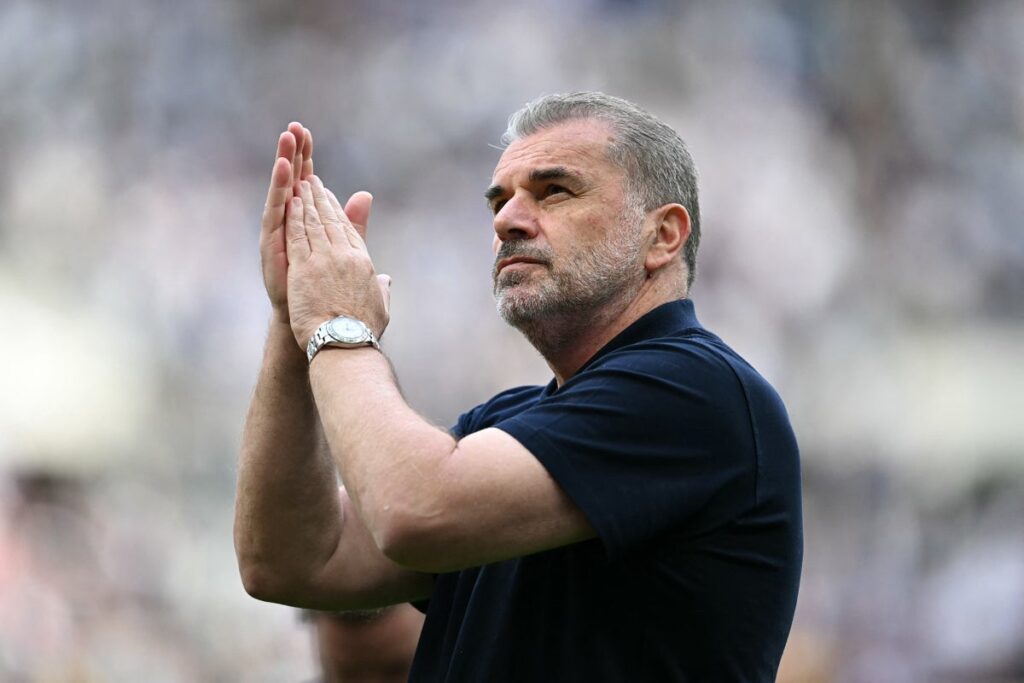
He will always have Bilbao. The manager who, in his forties, was in charge of Whittlesea Zebras in the Melbourne suburbs won a European trophy 16 years later. No other manager has had a journey quite like his. Angus Postecoglou But then no one has had a season quite like Tottenham’s, the club that recorded the lowest ever league finish of any side to lift continental silverware.
It was why the emotional choice would have been to keep Postecoglou. The rational one, delivered 16 days after. Europa League glory was to dismiss him.
“One of the toughest decisions we have had to make,” Spurs said in their explanation, and an easy target as chairman Daniel Levy can be, he deserves some understanding in this instance Postecoglou ended a 17-year wait for a major honour and dragged Tottenham to a historic low. The impression in his heady first few months was that he was a manager who brought back the Spurs way.
Tottenham’s traditions involved being a cup team, but never to this extent, never as inept in the league. The embarrassment of finishing 17th could only partly be attributed to a focus on Europe; they were 13th domestically even before playing a knockout tie in the continental competition. the probability is that any successor – and Thomas Frank is the frontrunner – will finish higher in the table but not win anything.
Postecoglou’s bold claim that he always won something in his second season was justified, and he described his sophomore year with Spurs as “outstanding.” However, it was also notable for many negative reasons. Tottenham suffered their most league defeats in a single campaign, losing 22 matches. Among these, 10 losses occurred at home, where fans who paid notoriously high ticket prices witnessed Ipswich and Leicester secure victories in N17. Their total of 38 points, assuming three points for a win in every season, marked Spurs’ lowest since the 1914-15 season. Given what is likely the seventh-highest wage bill, a talented squad of players, and an expenditure on transfers of around £400 million over the past couple of years, this was a significant underperformance on an extraordinary scale.
Given that winning European silverware was to be claimed, especially in the context of Tottenham’s inability to win anything since 2008, it only required one remarkable result, the away win over Eintracht Frankfurt in the quarter-finals. Even the final was against a Manchester United team who finished 15th in England.
So Tottenham had to conduct an assessment of Postecoglou’s reign and the whole season. They cited his record over the 66 league games that followed the heady beginning of the first 10 that produced 26 points and a table-topping start. Those 66 matches produced just 78 points, an average of just 1.18 per game. Of the 17 clubs in the division throughout that time, only Wolves took fewer points, and by a mere one. Spurs conceded 116 goals in that time, 1.76 per match.
It highlighted a design flaw in Angeball: vulnerability to counter-attacks. The warning signs were present during his debut campaign when, individually, the first-choice back four and goalkeeper all had excellent seasons, yet Tottenham conceded 61 goals. When Angeball was at its best, it was brilliant; the 4-0 thrashing of Manchester City this season was football at a very high level. However, there was no consistent formula for winning games.
He was not the first managerial import to struggle against the Premier League Postecoglou also had other issues. He was irritated by suggestions that his training and tactics injured his players, but Tottenham struggled to compete on multiple fronts; they won the Europa League by sparing Cristian Romero and Micky van de Ven Premier League duties. But, again, that blueprint scarcely felt repeatable as they enter a Champions League season.
Tottenham’s league form, ultimately, was impossible to justify. Postecoglou instead seemed to believe that his was the only team to suffer from injuries, as though everyone else could be judged by their results, but Spurs should not be. There were the car-crash post-match interviews of a manager who seemed to regard questioning of his methods and style of play as illegitimate.
On a personal level, he nevertheless merits considerable sympathy. The Europa League gives him a place in history: the third Tottenham manager, alongside the great Bill Nicholson and Keith Burkinshaw, to win European silverware, the first Australian coach to do so with any club. He released a dignified statement on his departure “My overriding emotion is one of pride,” he said.
But one of the questions his employers had to answer was whether it would be substantially different if they persevered with Postecoglou for another year. To reframe it, and despite the Europa League, would another Premier League club appoint Postecoglou now? After all, if he took Tottenham to 17th, logic may dictate he could relegate a mid-table club.
If many managerial appointments are the opposite of the previous one, it is notable that those who have seemed on Spurs’ radar – Andoni Iraola, Marco Silva, Oliver Glasner, and Frank – have found ways to get results with lesser resources in England, punching above their weight with mid-table teams. But as he leaves, Postecoglou can argue he was the antithesis of managers like Mauricio Pochettino, Jose Mourinho, and Antonio Conte. Because none of them took a trophy to Tottenham. And he did.