
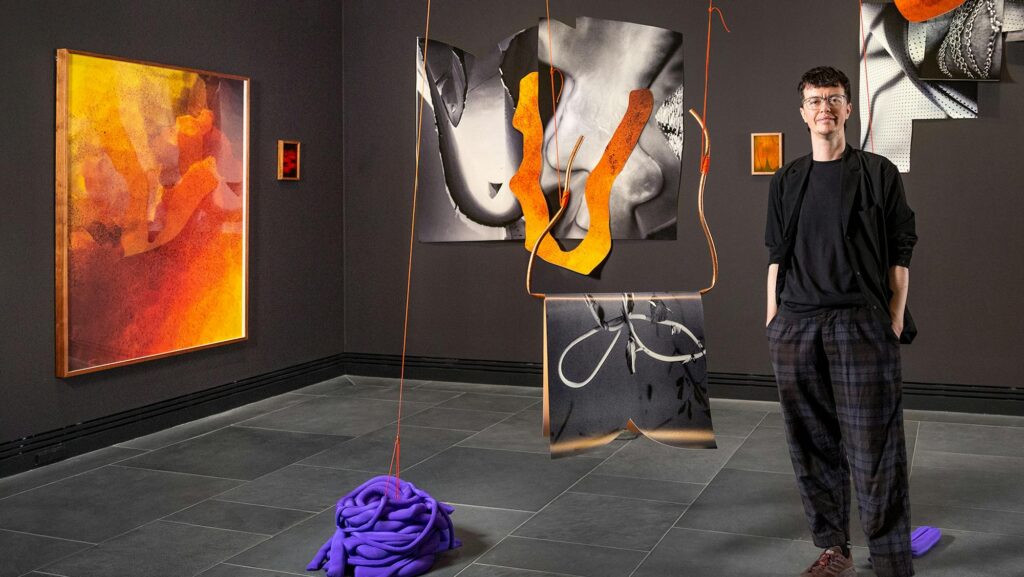
Jack Ball, a trans artist based in Sydney, was awarded the 2025 Ramsay Art Prize at the Art Gallery of South Australia for an immersive installation titled Heavy Grit.
The inspiration for the photo-collage and sculptural artwork stems directly from the artist’s exploration of the Australian Queer Archives in Melbourne – especially the scrapbooks covering the closeted decades of the 1950s to 1970s – and the merging of the past with the present.
The grainy print surface of the photo-collage elements, drawing on newspaper clippings, is arranged as four semi-abstract fluid shapes.
Collage allows Ball to layer archival material with his own photographic practice, to cut, crop, resize, and imply ambiguity and possibility in the blurred imagery.
The collages sit beside small photographs placed behind textured stained glass that seem like peep shows into queer culture, and are emblematic of Heavy Grit’s tension between what is revealed and what is hidden.
Beneath are sand-filled soft sculptures, all of which suggest intimacy, stolen moments, the bright lights of Oxford Street, queer dress culture and much more, set off by loose flourishes of orange framing the collage. There is a delicate play of surface, scale, and medium in an expansive installation that requires close, but slow looking.
The Ramsay Prize
The A$100,000 prize, awarded every two years, is open to artists under 40.
It is the nation’s richest art prize for that age category and is funded in perpetuity by the Ramsay Foundation, for artwork in any medium.
It is visionary in intent and reflects donors Diana and James Ramsay’s aim “to support and encourage contemporary Australian artists to make their best work at a pivotal point in their career.” And it has done just that.
It commenced in 2017. Vincent Namatjira, who was awarded the prize in 2019, proceeded to win the Archibald Prize. Kate Bohunnis (2021) and Ida Sophia (2023) winning attribute The Ramsay’s career change.
Well done on the performance
There is much strong work across a range of media areas on show in this year’s exhibition.
Arrernte artist Alfred Lowe’s ceramic sculptural figures are adorned with bright pink raffia skirts. But beneath the color and whimsy and contrasting materials is an exploration of his conflicted First Nations world of Central Australia and its charged politics.
Tom Polo’s brightly colored abstract and gestural paintings of fragmented and exaggerated forms suggest human vulnerability and the fluidity of daily life.
Bridie Gillman’s evocative “Pink Room, Pink Womb” painting is a double-sided triangular installation that references ideas of place and belonging.
It was produced in response to staying in an 18th-century bedroom with pink walls in Portugal. The dramatic color changes she observed according to the light conjured up notions of a deep maternal presence. She invokes this in her changing shades of pink on the canvases and base, accompanied by a subtle soundscape by Reuben Schafer.
Shireen Taweel’s meticulous suspended copper objects explore astronomical matters, the contribution of a Persian polymath’s foundational work in trigonometry, and the precision required to locate stars and other celestial bodies.
She emulates that precision in her intriguing copper installation, while Al-Tusi preferred to rely on perfect circles instead, as an instrument for astronomical observation. Her pierced motifs in the copper are informed by precise calculations.
Chinese-Australian artist Jason Phu draws on his cultural heritage in his large painting. Comic-like figures enact a narrative across time, as occurs in more serious Chinese Scroll paintings.
Phu subverts tradition, adds a vernacular touch, and oscillates between humor and grim despair. His central figure in red enacts the text above: “the deepest love, the deepest despair”.
David Attwood’s whimsical kinetic sculptural assemblage featuring a motorized house cleaning sponge harks back to the wacky idea of a self-cleaning house and touches on the gendered nature of housework.
Liam Fleming was schooled in the refined precision and techniques of making production line glass. Here, his slumped glass sculptural work comes from his “letting go” of this exactness.
Greek-Australian queer artist and designer Jordon Gogos’ impressive large tapestry, Time Machine, is made from repurposed and recycled textiles, and explores memory and identity.
His skillful blend of chance and design – and expanding the possibilities of fabric through layering, embroidery, and felting – results in a compelling and playful piece.
These are just eight of the artworks on show in which the experimentation, range, diversity and rich cultural mix point to a vibrant contemporary art scene.
What’s left unsaid
But among the 22 finalists – a veritable who’s who of the contemporary art scene – only one artist reflects on war in a world beset by conflict.
Ukrainian-born Stanislava Pinchuk is currently Australia’s official war artist in Ukraine. Her moving image work, “Theatre of War,” focuses on three such “theatres”: the siege of Sarajevo, the war in Ukraine, and Homer’s account of the Trojan War in the Iliad.
But where is the bravery of earlier Ramsay entries such as Hoda Afshar’s moving photographic portraits of our courageous whistleblowers in? Agonistes, which was featured in the 2020 Ramsay Art Prize exhibition?
There were close to 600 entries this year, so it seems odd that no-one else was selected for the final cut whose work had overt political content such as the war in Gaza.
The Ramsay Art Prize 2025 is at the Art Gallery of South Australia until August 31.
Catherine Speck has received funding from the ARC to investigate Australian art exhibitions (with Joanna Mendelssohn, Catherine De Lorenzo and Alison Inglis).