
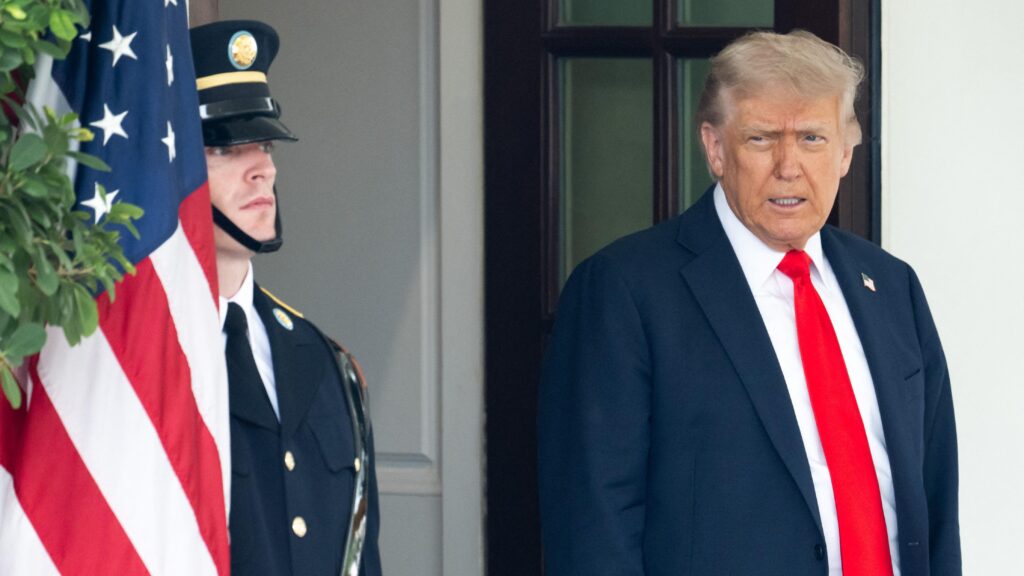
The ban or restriction on entry into the United States decreed by President Donald Trump on Wednesday will affect citizens of 19 countries.
Citizens of 12 nations face a total ban and those from seven other countries face partial restrictions under a measure that goes into effect on Monday, June 9.
Trump has described it as a matter of national security. He cited a recent attack against members of the Jewish community in Colorado, allegedly carried out by an Egyptian citizen. However, Egypt is not on the list of banned countries.
Other reasons cited include the alleged violation of U.S. visa rules by citizens of the countries in question.
Here are some of the president’s arguments.
Venezuela and Cuba
Venezuela is accused of lacking a competent or cooperative central authority to issue passports and similar documents.
It is also mentioned that Venezuelan citizens remain in the USA beyond the validity of their visas, and the Venezuelan government’s refusal to accept deportees.
In response, Venezuelan Minister of Interior Relations, Justice, and Peace, Diosdado Cabello, stated that “being in the USA is a great risk for any person, not just for Venezuelans.”
“Those who govern the U.S. are bad people, it’s fascism, they are the supremacists, those who think they own the world. And they persecute our people, and they persecute our community without any reason,” he assured.
Cuba, meanwhile, is labeled as another “State sponsor of terrorism,” a designation made by the U.S. in 2021 and condemned by Havana.
The document states about Cuba: it is described as “a state sponsor of terrorism that does not cooperate or share sufficient police information with the United States and has historically refused to accept the return of its deported nationals.”
It also indicates the percentage of visa beneficiaries who exceed the authorized stay time in the U.S.
The entry of Cuban nationals to the United States as immigrants and as non-immigrants with B-1, B-2, B-1/B-2, F, M, and J visas is suspended.
These visas are those issued for business reasons (B-1), tourism (B-2), for both of these reasons combined (B-1/B-2), for students who will study at American educational institutions (F) or those pursuing professional or non-academic studies (M), and the one given to individuals participating in exchange visitor programs, such as cultural or research exchanges (J).
Haiti
The document highlights that “hundreds of thousands of illegal Haitian foreigners flooded the United States during the Biden administration.”
Trump points out the risks this has entailed, such as the creation of “criminal networks” and the high rate of overstaying visas.
The U.S. Census Bureau data suggests that more than 852,000 Haitians were living in the U.S. in February 2024, although it does not offer a breakdown of when those migrants arrived.
Many migrated after the devastating 2010 earthquake or fleeing the violence of gangs that took over the Caribbean country.
The U.S. president also points out the lack of central authority in Haiti regarding matters such as law enforcement.
Afghanistan
The presidential proclamation signed by Trump pours a series of accusations against Afghanistan.
The document highlights that the Taliban, who control the country, are a “globally designated terrorist group” (SDGT for short in English).
The measure comes just a few weeks after the Trump administration seemed to indicate that it believed the situation had improved in Afghanistan, when it announced the end of Temporary Protected Status (TPS) for Afghans living in the United States.
Moreover, Trump accuses Afghanistan of lacking a “competent or cooperative” central authority to issue passports or civil documents.
As with other countries on Trump’s list, the issue of Afghan citizens exceeding the validity period of their visas is also cited.
Iran
Trump’s proclamation identifies Iran as a “state sponsor of terrorism,” an accusation that the Islamic Republic has been rejecting for a long time.
The United States previously censored Tehran for its alleged sponsorship of groups operating in the region, such as Hamas and Hezbollah.
The new proclamation by Trump states that the country is a “significant source of terrorism worldwide,” does not cooperate with the U.S. on security risks, and “has historically not accepted back its expelled nationals.”
The measure comes amid diplomatic disputes between the two parties over the creation of a new agreement on Iran’s ability to manufacture nuclear weapons.
Somalia and Libya
Similar reasons are cited in the case of Somalia. The African country in the east of the continent is labeled by Trump as a “terrorist haven.”
Like Iran, it is also accused of not accepting its nationals when they are expelled from the United States.
However, Trump made another observation: “Somalia stands out among countries in the extent to which its government lacks control and command of its territory, which severely limits the effectiveness of its national capabilities in various aspects.”
The federal government of Somalia is facing a significant challenge from armed Islamists. It has committed to “initiate a dialogue to address the concerns raised” by Trump.
Libya, located in North Africa, is cited for its “historic terrorist presence,” which is presented as a threat to the security of Americans.
Libya and Somalia are also among the countries on Trump’s list that have been criticized for their alleged incompetence in issuing passports.
Chad, Republic of the Congo, Equatorial Guinea
Trump exclusively accuses these countries of having relatively high rates of citizens who remain in the U.S. after their visas have expired.
The Department of Homeland Security (DHS) defines a person who “exceeded their stay” as someone who remains in the United States beyond their authorized period of admission, without evidence of an extension.
The “rate” indicates the proportion of people who exceeded their stay limit.
Chad, a Central African country, is pointed out for showing blatant disregard for the United States’ immigration laws.
The document highlights an excessive retention rate of 49.54% in the country among Chadians with business or tourist visas in 2023, citing a DHS report.
Congo-Brazzaville and Equatorial Guinea have rates of 29.63% and 21.98%, respectively. However, these figures are lower than those of Laos, which faces a lesser restriction.
Myanmar
Myanmar —mentioned as Burma in Trump’s proclamation — is also accused of a high rate of overstaying after the visa expiration.
Al igual que otros países de la lista, incluido Irán, el país también está acusado de no cooperar con Estados Unidos para aceptar a los ciudadanos birmanos deportados.
Eritrea, Sudán and Yemen
For each of these countries, Trump’s first accusation is their questionable competence in issuing passports and civil documents.
Eritrea and Sudan are also accused of having relatively high rates of overstaying visas in the country.
In addition, Eritrea is blamed for not providing the United States with the criminal records of its citizens and for refusing to accept deported citizens.
As in the case of Somalia, Yemen is accused of lacking control over its own territory.
The proclamation by Trump highlights that it is a scene of active U.S. military operations. The United States has been fighting against the Houthis, who have seized much of the north and west of the country during an ongoing civil war.
Long stays with a visa are presented again as the key issue in the cases of Burundi, Laos, Sierra Leone, Togo, and Turkmenistan.
The ban on entry to the United States will be in effect until the affected countries “remedy the deficiencies or correct the causes” mentioned in the proclamation.